
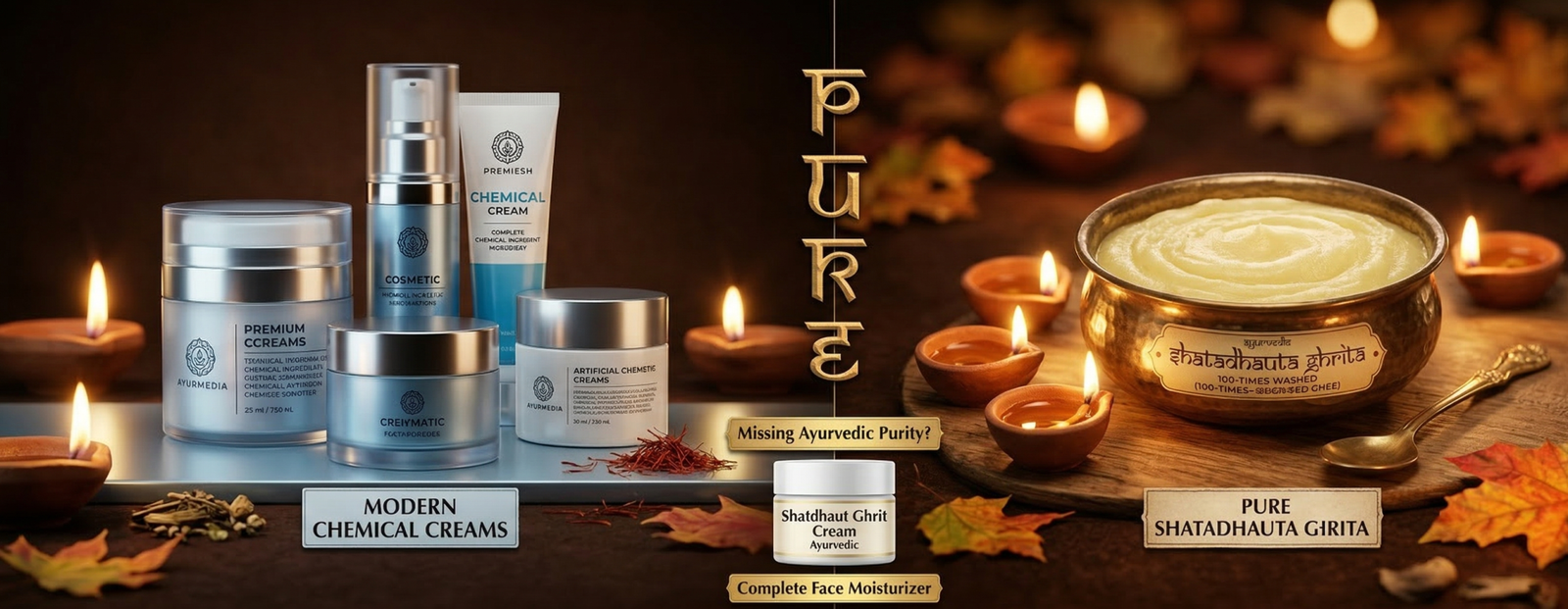
If you’ve spent any time in Ayurvedic skincare corners of the internet lately, you’ve probably run into Shata Dhauta Ghrita — usually described as “ghee washed a hundred times,” shown in a slow-motion video of someone rhythmically rinsing ghee in a copper bowl, looking suspiciously like a meditation ritual. It’s easy to dismiss as another wellness trend dressed up in ancient language. Except this one’s actually ancient.
Let’s go through what it really is, why the washing matters, whether making it yourself is worth the effort, and what it can and can’t realistically do for your skin.
What “100 times washed” actually means
The name breaks down exactly as it sounds: Shata (hundred), Dhauta (washed), Ghrita (ghee). You start with pure cow ghee, add water, rub the two together by hand until they combine, then drain the water off. Then you do it again. And again — traditionally, a hundred times.
Here’s the part that’s easy to miss: this isn’t ghee with water mixed in. Each wash physically changes the ghee’s structure. The fat globules get smaller and smaller with every round of agitation, and the texture shifts from a thick, oily fat into something closer to a whipped, featherlight cream. By the end, you’re left with a substance that looks nothing like the ghee you started with — pale, soft, faintly cooling to the touch, and far lighter on skin than a spoon of plain ghee ever would be.
The tradition behind it goes back to classical Ayurvedic texts like the Charaka Samhita, where it’s described as a Ropana — a tissue-healing, wound-supportive preparation. Historically, it was used to soothe burns, calm irritated skin, and support recovery after skin injury, often applied alongside other herbs depending on the specific concern.
Does the copper vessel actually matter, or is that just tradition?
This is one of the more genuinely interesting parts. Copper isn’t just a nod to ritual — it has measurable antibacterial properties, and trace amounts of copper transfer into the ghee during the repeated washing process. That same trace copper is also associated with supporting collagen and elastin production in skin. So while you could technically make a version of this in a steel or glass bowl, the copper vessel isn’t pure tradition for tradition’s sake — it changes the final product in a small but real way.
Should you actually try making it at home?
Honestly, this is where most online guides get a little dishonest with you. Yes, you can make a rough version at home. No, it isn’t simple, and the results vary a lot more than the cheerful blog posts suggest.
A few honest realities if you’re considering the DIY route:
- It’s genuinely time-consuming. Even a scaled-down version — 20 to 30 washes instead of a hundred — takes a real chunk of focused time, not five minutes between chores.
- Hand-rubbing matters more than people admit. Using a mixer or blender introduces heat, which works against the process and often leaves you with an oily, unstable batch instead of a smooth cream.
- Your starting ghee determines everything. If the ghee you begin with is stale, adulterated, or heavily processed, no amount of careful washing fixes that. The technique can’t outperform the raw material.
- Hygiene is non-negotiable. Since the final product retains a small amount of water, contamination risk is real if your water source or vessel isn’t clean. A poorly made batch can spoil or grow bacteria far faster than plain ghee would.
If you enjoy slow, ritual-style skincare projects and have the patience for it, it’s a genuinely meditative thing to make. If you just want the result without the multi-hour process and the trial-and-error of getting the texture right, that’s a completely reasonable reason to buy a properly handcrafted version instead — it isn’t cutting corners, it’s just outsourcing a labour-intensive traditional process to people who do it daily and have already solved the consistency problem.
What it can realistically do for your skin
Strip away the more dramatic claims you’ll see floating around (and there are some bold ones — eczema, psoriasis, herpes recovery — that really belong in a doctor’s hands, not a skincare jar), and here’s what’s left, grounded and real:
- Deep, lasting hydration without the greasy after-feel of regular ghee, thanks to how finely broken down the fat structure becomes.
- A calming effect on sun-stressed or irritated skin, largely due to ghee’s naturally cooling properties in Ayurvedic terms (it’s classed as having a cold potency, or Sheeta Virya).
- Nourishment from fat-soluble vitamins A, D, E, and K, which are naturally present in good-quality ghee and support general skin barrier health.
- A genuinely gentle alternative for people whose skin reacts to synthetic fragrances, preservatives, or heavy actives in conventional moisturizers.
What it isn’t: a treatment for diagnosed skin conditions, a guaranteed fix for old scarring, or an overnight miracle. It’s a deeply traditional, well-made moisturizer with a longer, more interesting backstory than almost anything else on your shelf — and for dry, sensitive, or reactive skin, that backstory comes with real, practical benefits.
The takeaway
Shata Dhauta Ghrita isn’t hype dressed up as ancient wisdom — it’s ancient wisdom that happens to have come back into fashion. The washing process is real, the copper vessel does something measurable, and the end result is a genuinely different substance from the ghee sitting in your kitchen. Whether you make your own patient, hand-washed batch or reach for a shata dhauta ghrita cream that’s already been through the full hundred washes, you’re tapping into one of the oldest, simplest ideas in skincare: sometimes the most effective thing you can put on your skin is also the least complicated.
If you’re dealing with a diagnosed skin condition like eczema, psoriasis, or persistent scarring, please see a dermatologist rather than relying on home remedies alone — traditional moisturizers like this work best alongside proper care, not instead of it.
How to use Shata Dhouta Ghrita wisely