
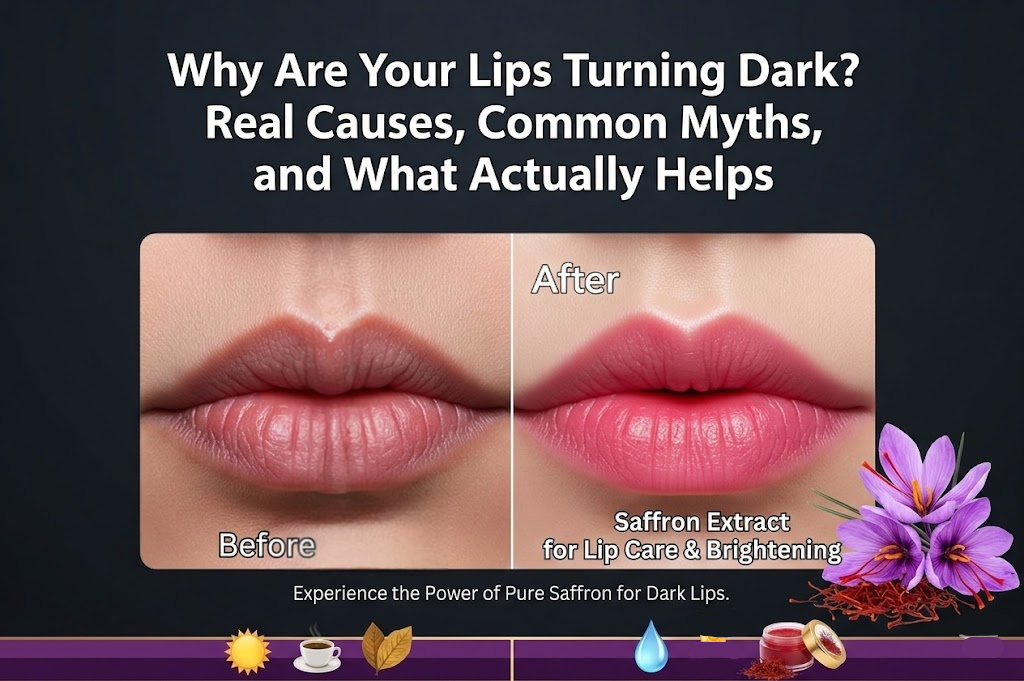

If you’ve caught yourself staring at your lips in the mirror lately, wondering when exactly they started looking darker around the edges — you’re not imagining it, and you’re definitely not the only one. It’s one of the most common skin concerns people search for help with, right up there with dark circles and dull skin. And just like with dark circles, the internet is full of half-true advice about it.
Let’s actually unpack what’s going on, before getting into what helps.
Your lips age differently than the rest of your face
Here’s the part most people don’t know: the skin on your lips has no oil glands and very little melanin protection compared to the rest of your face. That’s why lips dry out faster than your cheeks, and it’s also why they’re more vulnerable to sun damage, friction, and pigmentation. Your lips simply don’t have the same built-in defences your skin does.
So when your lips start looking darker, dryer, or patchier, it’s rarely “just one thing.” It’s usually a combination of small, everyday habits adding up over months.
What’s actually causing it
Sun exposure. Lips don’t tan evenly — they pigment unevenly, which is why you’ll often see darker patches at the corners or along the lower lip first. Daily sun exposure without any protection is one of the biggest, and most overlooked, contributors.
Dehydration. When your body is short on water, your lips are usually the first place it shows. Chronic dryness leads to cracking, and repeated cracking and healing cycles can leave behind pigmentation over time.
Licking your lips. It feels soothing in the moment, but saliva actually dries lips out faster once it evaporates, and the enzymes in it can irritate the thin skin with repeated contact. It’s a habit loop — the drier your lips get, the more you lick them, the worse it gets.
Smoking and caffeine. Both restrict blood flow to the lips and are well documented contributors to lip darkening, particularly along the edges.
Cheap or expired makeup. Long-wear and matte lipsticks are notorious for pulling moisture out of lips, and low-quality pigments can react with sun exposure (a reaction called photosensitivity), leaving discolouration behind.
Allergic reactions. Sometimes it’s not pigmentation at all — it’s a mild, ongoing reaction to a lip product, toothpaste, or even a fruit, showing up as darkness and dryness combined.
What doesn’t actually work (and may make it worse)
A lot of “hacks” floating around — aggressive lemon juice application, harsh DIY scrubs done daily, or constant exfoliation — can do more harm than good. Lemon juice in particular is acidic enough to irritate already-thin lip skin, and over-exfoliating breaks down the lip barrier rather than repairing it. If something stings the moment you apply it, that’s a sign it’s working against you, not for you.
What genuinely helps
The good news is that lip pigmentation from sun, dryness, and habit (as opposed to a medical condition) is very responsive to consistent, gentle care. A few things make a real difference:
- Stop licking your lips. Easier said than done, but it’s the single highest-leverage habit change.
- Hydrate consistently, not just when they feel dry. Lips need moisture maintained, not just rescued.
- Protect them in the sun, the same way you would your face.
- Exfoliate gently, once or twice a week — never daily — to clear dead skin without irritating the new skin underneath.
- Use ingredients that nourish, not just coat. This is where the difference between an occlusive balm (think petroleum jelly, which simply sits on the surface) and a nourishing one really shows.
Why Ayurveda has been solving this for centuries
This is exactly the problem Kumkumadi Thailam was designed to address — and it’s been used in Ayurvedic skincare for hundreds of years, long before “lip pigmentation” was a Google search. Made from Kashmiri saffron, sandalwood, manjistha, and licorice in a base of nourishing oils, it was traditionally used to even out skin tone anywhere it was applied, lips included.
In Ayurvedic terms, dry, chapped, and discoloured lips are often a sign of aggravated Vata dosha — the body’s air-and-space energy, which governs dryness and depletion. The Ayurvedic approach isn’t to mask the symptom; it’s to feed the tissue with warm, nourishing ingredients that work with the skin rather than just sitting on top of it.
This is also why a kumkumadi lip balm tends to work differently from a standard drugstore balm. Instead of an occlusive layer that needs constant reapplication, the saffron and herbal actives in Kumkumadi Thailam target the pigmentation itself, while the butters and oils handle deep, lasting hydration — so you’re treating both problems at once instead of just papering over one of them.
A realistic timeline
If you switch to consistent, nourishing lip care today, here’s roughly what to expect:
- Days 1–3: Less tightness, less need to reapply every hour.
- Week 1–2: Visibly less flaky, softer texture in the mornings.
- Month 1 onward: Gradual evening out of dark patches, with lips slowly returning to a more natural, rosy tone.
Patience matters here. Anything promising overnight bleaching of your lips is overselling it — real improvement, the kind that actually lasts, happens in weeks, not days.
The bottom line
Dark, pigmented lips are almost always a habit-and-care issue, not a sign of anything wrong with you. Sun, dehydration, lip-licking, and harsh products are the usual suspects, and all four respond well to a simple, consistent routine built around hydration and gentle, nourishing ingredients like Kumkumadi Thailam. Give it a few weeks before judging whether something is working — your lips heal slower than the rest of your face, but they do heal.
If you notice sudden, unexplained dark patches, swelling, or a lip texture change that doesn’t improve with care, it’s worth getting it checked by a dermatologist rather than self-treating — most pigmentation is cosmetic, but it’s always worth ruling out anything else.
Also check kumkumadi lip balm how to use